Video Transcript

Imagine you're entering the Rotunda of the United States Capitol as the designers intended.

You climb the temple-like stairs of the East Front and walk into a vast space and encounter these mural-sized paintings by John Trumbull.

[ THE ROTUNDA ]

Installed in 1826, they depict four Revolutionary Era scenes, two civil and two military, illustrating events that are foundational to America's origin story.

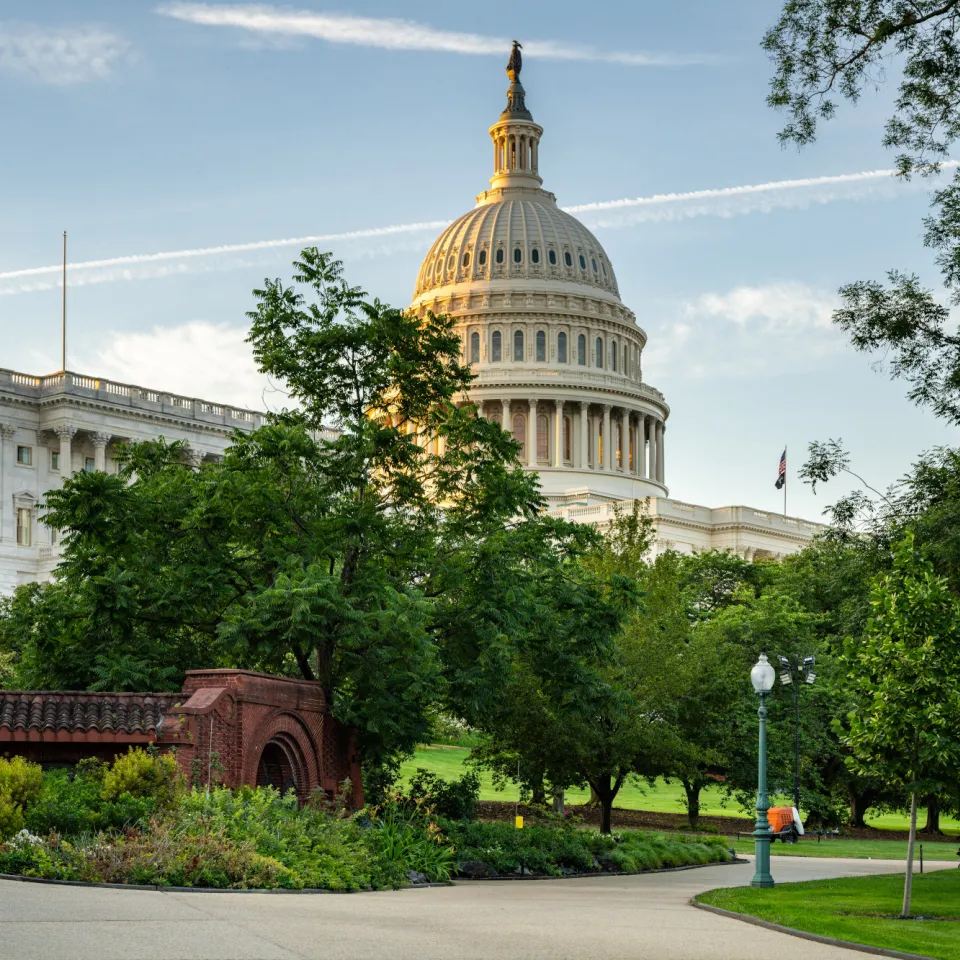
The Rotunda of the United States Capitol has been described as the nation's political heart.

This awe-inspiring space conveys the power not of church or monarch, but of government by and for the people — the very idea that Trumbull wanted to emphasize.

At its inception, the Rotunda's function was open-ended and symbolic, fertile ground for the addition of paintings, murals and sculpture that would augment its meaning.

On drawings by architect William Thornton and then by his successor, Benjamin Henry Latrobe, the Rotunda was referred to as the "Grand Vestibule" and "Hall of the People."

Since its completion in 1826, the Rotunda has served as a civic museum and national stage for joint House and Senate events, and grand public ceremonies, including the lying in state of eminent citizens.

Because of its immense size and monumental art, it has always been a tourist attraction, a sort of pilgrimage site drawing visitors to the center of Washington, D.C.

[ THE PAINTINGS ]

In 1817, Congress commissioned John Trumbull to undertake these four paintings for the Capitol Rotunda. The first such commission made to an American artist for a space that was not yet built and the first instance when Congress was a patron of the arts.

The four paintings that Trumbull completed are the Declaration of Independence, followed by the surrender of Lord Cornwallis at Yorktown, the surrender of General Burgoyne at Saratoga, and to complete the series, the resignation of General Washington.

[ DECLARATION OF INDEPENDENCE ]

The first painting to be completed in the series was the Declaration of Independence. It depicts the moment on June 28th, 1776, when the first draft of the Declaration of Independence was presented to the Second Continental Congress, a sequence of events that Trumbull distills into one image.

In the central group in the painting, Thomas Jefferson, the principal author of the declaration, is shown placing the document before John Hancock, president of the Congress. With him stand the other members of the committee that created the draft: John Adams, Roger Sherman, Robert Livingston, and Benjamin Franklin.

There were 56 signers of the Declaration of Independence. Trumbull represented 47 figures, including five who were not signers. He took artistic license to depict Jefferson not alone, but among other members of the drafting committee.

The Declaration provides a fascinating case study about Trumbull's artistic process. It likely began when Trumbull was Jefferson's guest in Paris in the fall of 1786.

Trumbull intended to include all 211 figures, but he was unable to obtain all the likenesses. Of the 47 portraits here, 36 were taken from life. Others were copied from an existing portrait or taken of a son as a substitute.

[ SURRENDER OF LORD CORNWALLIS ]

The second painting that Trumbull completed for the Rotunda was of the surrender of Lord Cornwallis.

The subject of this painting is the surrender of the British army at Yorktown, Virginia in 1781, which ended the last major campaign of the Revolutionary War.

The blue sky filled with dark clouds and the broken cannon suggest the battles that led to this event.

In the center of the scene, American General Benjamin Lincoln appears mounted on a white horse. He extends his right hand toward the sword carried by the surrendering British officer who heads the long line of troops that extends into the background.

To the left, French officers appear standing and mounted beneath the white banner of the royal Bourbon family.

On the right are American officers beneath the stars and stripes. Among them are the Marquis de Lafayette and Colonel Jonathan Trumbull, the brother of the painter.

General George Washington, riding a brown horse, stayed in the background because Lord Cornwallis himself was not present for the surrender.

[ SURRENDER OF GENERAL BURGOYNE ]

The third painting that Trumbull completed was the surrender of General Burgoyne at Saratoga, finished in December of 1821.

Burgoyne is in the center and to his left is William Phillips, a British major general. Gates is in the center, where he refuses Burgoyne's sword and instead offers hospitality by directing Burgoyne to the tent to take refreshment.

The American flag flies in the wind at the top of the tent. American officers gather at the sides to witness the event. Their varied dress reflects their different units. Most were not actually at the event, but would have been below near the river with their troops.

Trumbull is depicting people who were there the day of the surrender, but not witnessing the actual ceremony.

Trumbull takes artistic license with the landscape, the assembled group of figures, the tent, which would have been a tarp on poles, and even the flag itself may not have been the one that was flown. The cannon depicted was one of 47 artillery pieces surrendered to the American army at Saratoga.

The scene suggests peace rather than combat or hostility. Beneath the blue sky and white clouds, officers wear their dress uniforms, weapons are sheathed or slung, and cannons stand silent.

[ RESIGNATION OF GENERAL WASHINGTON ]

The fourth painting that Trumbull completed was Washington Resigning His Commission, executed between the spring of 1822 and the spring of 1824.

The composition depicts the scene on December 23rd, 1783, in the Maryland State House in Annapolis, when George Washington resigned his  commission as commander-in-chief of the Continental Army.

Washington, illuminated by the light falling into the room, stands in uniform before the president of the Continental Congress, Thomas Mifflin, and the delegates, among whom is Thomas Jefferson.

Behind Washington are his aides-de-camp, Colonel Benjamin Walker and Colonel David Humphreys, as well as spectators.

The delegates and spectators direct their attention to Washington as he extends his right hand to return his commission.

The empty chair draped in a cloak, suggestive of a throne covered with a king's robe, symbolizes Washington's act of retiring from his position of power.

Trumbull based the representation of George Washington on one of his own earlier portraits.

[ THE LEGACY OF JOHN TRUMBULL ]

The Rotunda's architecture provides a powerful setting for the paintings.

From a distance, the spectator cannot make out the individual portraits that constitute the mosaic of faces Trumbull painted into each scene. It is only when we get close that we can discern the facial features of young and old, farmers, merchants, and soldiers.

One could conclude that in some ways Trumbull sacrificed the whole for the parts, driven as he was by a notion of authenticity rooted in painstaking realism — that is, the realism of individual portraits.

Because Trumbull's mission was to convey the values he viewed as foundational to American democracy as he understood it: honor on the battlefield, self-restraint, and rational and orderly debate. He had to memorialize the actors central to the events he depicted.

However, today, two centuries later, the actions of the people Trumbull portrayed, rather than their faces, may resonate more for viewers.

Add a new comment

The content of this field is kept private and will not be shown publicly.

Plain text

  • No HTML tags allowed.
  • Lines and paragraphs break automatically.
  • Web page addresses and email addresses turn into links automatically.

Our Stories

Recent Articles
History & Discoveries

Capitol Extra! Magna Carta Replica and Display

Our Curator, Dr. Michele Cohen, is in the Capitol Crypt for the Magna Carta's anniversary. This entire display was made in England by artist Louis Osman, who had also crafted the crown for the investiture of Prince Charles.