The 100 statues that comprise the National Statuary Hall Collection span 150 years of American sculpture. They include neoclassical marbles and naturalistic bronzes by a range of artists, some with national and some with regional reputations. However, unlike many art museum collections, this one was shaped not by curators but by its donors; frequently, political interests more than artistic ones played a role in its formation. Its purpose is to honor notable individuals associated with a particular state, drawing recognition to the state via the individual.

The 1864 legislation authorizing the collection specified that subjects were to be "deceased persons who have been citizens [of the donating state], and illustrious for their historic renown or for distinguished civic or military services." Thus, historically, more attention has been given to the subjects depicted than to the artists behind the statues. The collection as a whole displays noticeable stylistic differences and artistic unevenness, but the best pieces share time-honored characteristics that endow them with artistic longevity.

Image
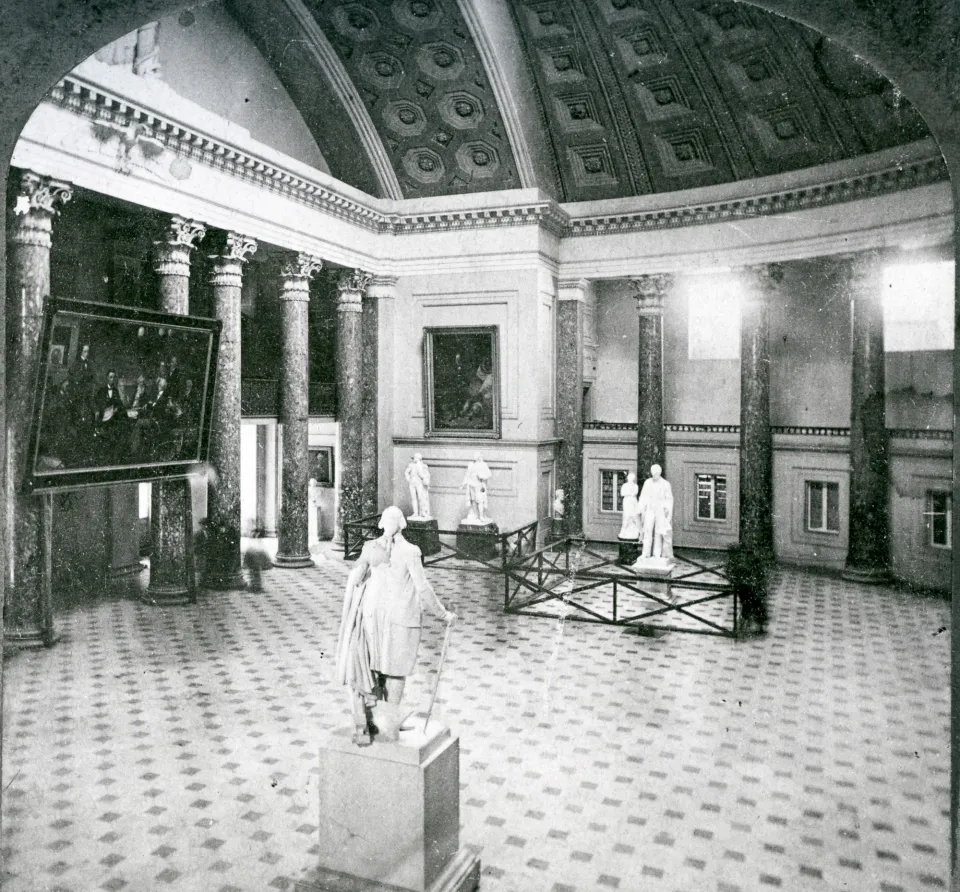
View of National Statuary Hall, circa 1873.

In 1864, when the authorizing legislation was enacted, sculpture was synonymous with figuration, the depiction of a recognizable human or animal form, and statues intended for permanent display were typically made of bronze or marble; therefore, in crafting the language that gave rise to America's first national hall of fame, legislators could only conceive of statues in the classical tradition of Greek and Roman marbles and bronzes—befitting the requested "illustrious" and "distinguished" subjects. Their assumptions were also influenced by the display space intended for the collection: the room to be used as National Statuary Hall was the remodeled former Hall of the House of Representatives, and this neoclassical space, designed by Benjamin Henry Latrobe, is regarded as one of the great Greek revival interiors of America.

In addition to celebrating notable Americans, the collection was intended to feature and encourage the work of American artists. The establishment of the National Statuary Hall Collection contributed to the growth of a national school of sculpture, providing opportunities and exposure for artists seeking patronage for large-scale figurative commissions.

In assessing artistic success, the most important aspect of a commemorative portrait statue is the figure's recognizability. Is the likeness accurate? Is this an authentic representation? Did the artist capture something about the sitter's personality or psyche? Is the pose engaging, and what does it say about the subject? What is the figure wearing, and what does the costume tell us? What accoutrements are associated with the figure, and what do these details reveal about the subject's accomplishments? Then there are technical aspects to consider. What is the overall quality of the execution of the finished statue? If marble, is the carving skillful? If bronze, is the cast flawless and does it exhibit a rich patina? Does light animate the statue's surfaces?

Image
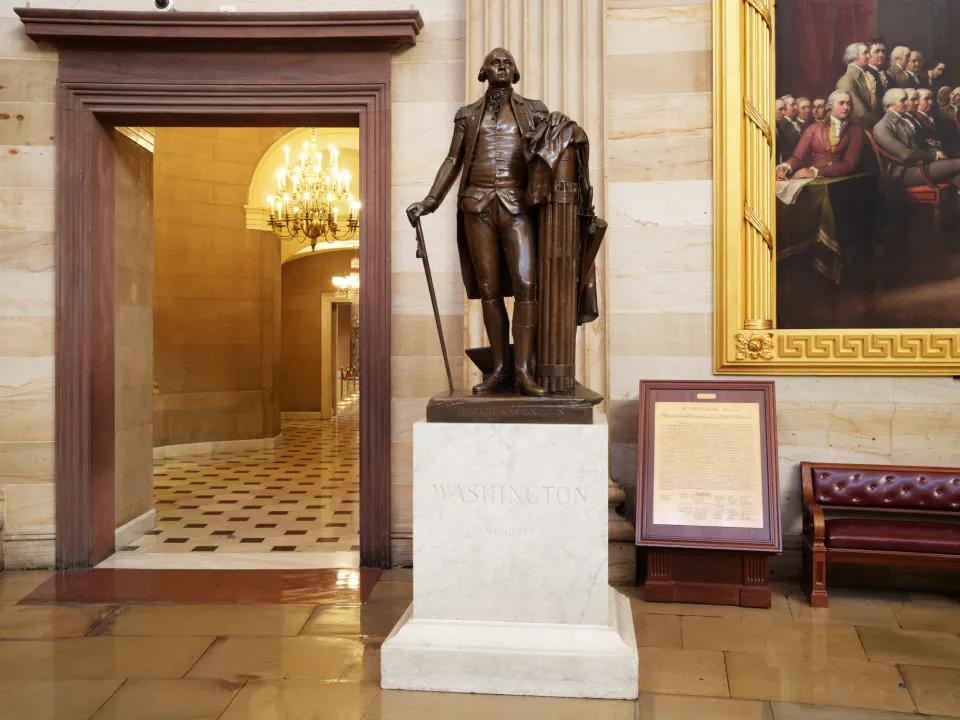
The bronze portrait statue of George Washington by Houdon in the U.S. Capitol.
Photo by
Luke Walter and Sean Greene
Image
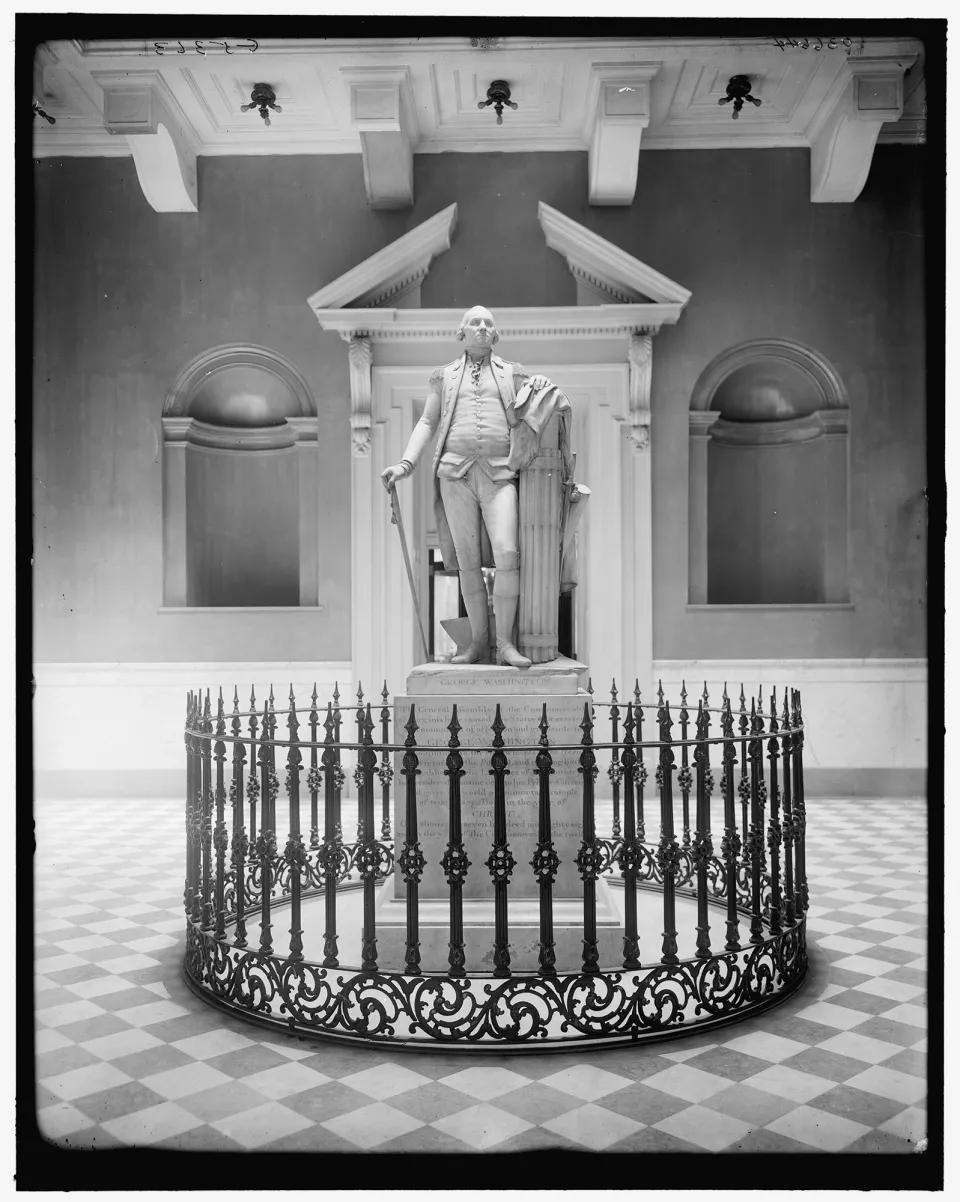
The marble portrait statue of Washington by Houdon in the Virginia State Capitol. Retrieved from the Library of Congress, https://www.loc.gov/item/2016811718/.

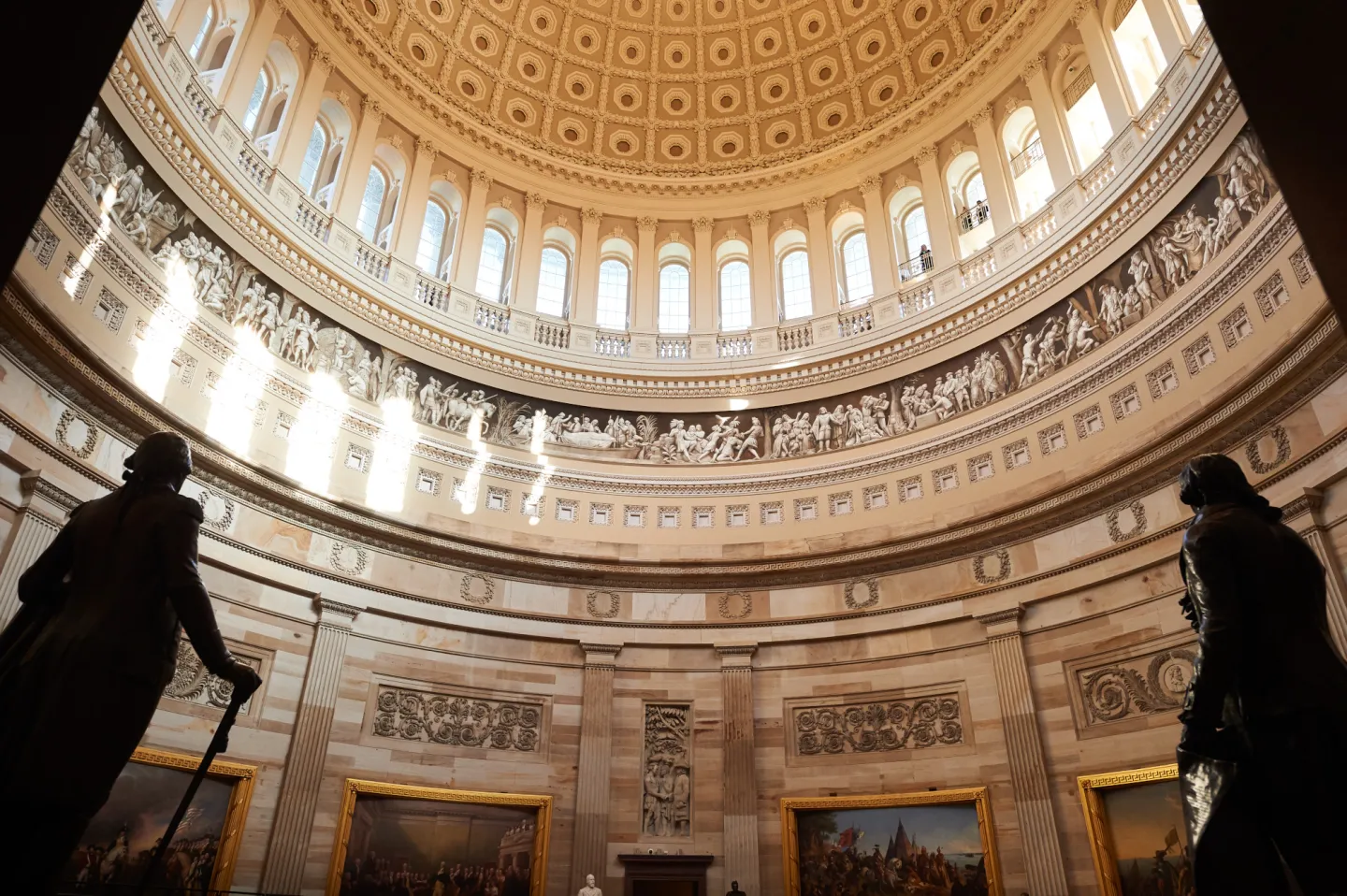
In approaching the challenge of creating a commemorative portrait statue, 19th-century American artists undoubtedly looked to precedents. The most important precedent that served as a model and inspiration for many of the early works in the National Statuary Hall Collection may well be Jean-Antoine Houdon's (1741-1828) marble statue of George Washington, commissioned in 1785 by the Virginia General Assembly for the new Virginia State Capitol. Thomas Jefferson, then in Paris, selected Houdon, an artist closely associated with the Enlightenment, and France's leading neoclassical sculptor. A bronze replica cast in 1909 stands in the U.S. Capitol Rotunda.

The Houdon statue is an exemplary model of a commemorative portrait statue, combining a convincing likeness with realistic details, simplicity, and a graceful naturalism. Houdon traveled to Mount Vernon, insisting on sculpting George Washington's likeness from life rather than basing it on a painting by Charles Wilson Peale. Remaining there for two weeks, Houdon made a life mask of Washington, fashioned a terra cotta bust, and took measurements of his body. Apparently when Washington's friend the Marquis de Lafayette saw the finished statue he declared:

“That is the man himself. I can almost realize he is going to move.”

Houdon's sensitively carved marble portrait statue of Washington is considered the definitive likeness of the nation's first president. Houdon portrays him as a calm commander looking into the distance. On Washington's request, Houdon dressed him not in a Roman toga, as was customary for official portraiture, but in contemporary clothes – his general's uniform. The uniform is slightly rumpled and is truthful to Washington's physique. His weight is shifted in a classical contrapposto stance and he holds a walking cane. He stands in front of a plowshare, a reference to his return to farming, but he is still the statesman, suggested by his hand resting on a podium fashioned as a fasces, a bundle of 13 rods, referring to the original 13 states. His sheathed sword hangs from the podium, a reminder of his military accomplishments. Everything about the statue reinforces the message of Washington's dual persona as a venerated general and private citizen.

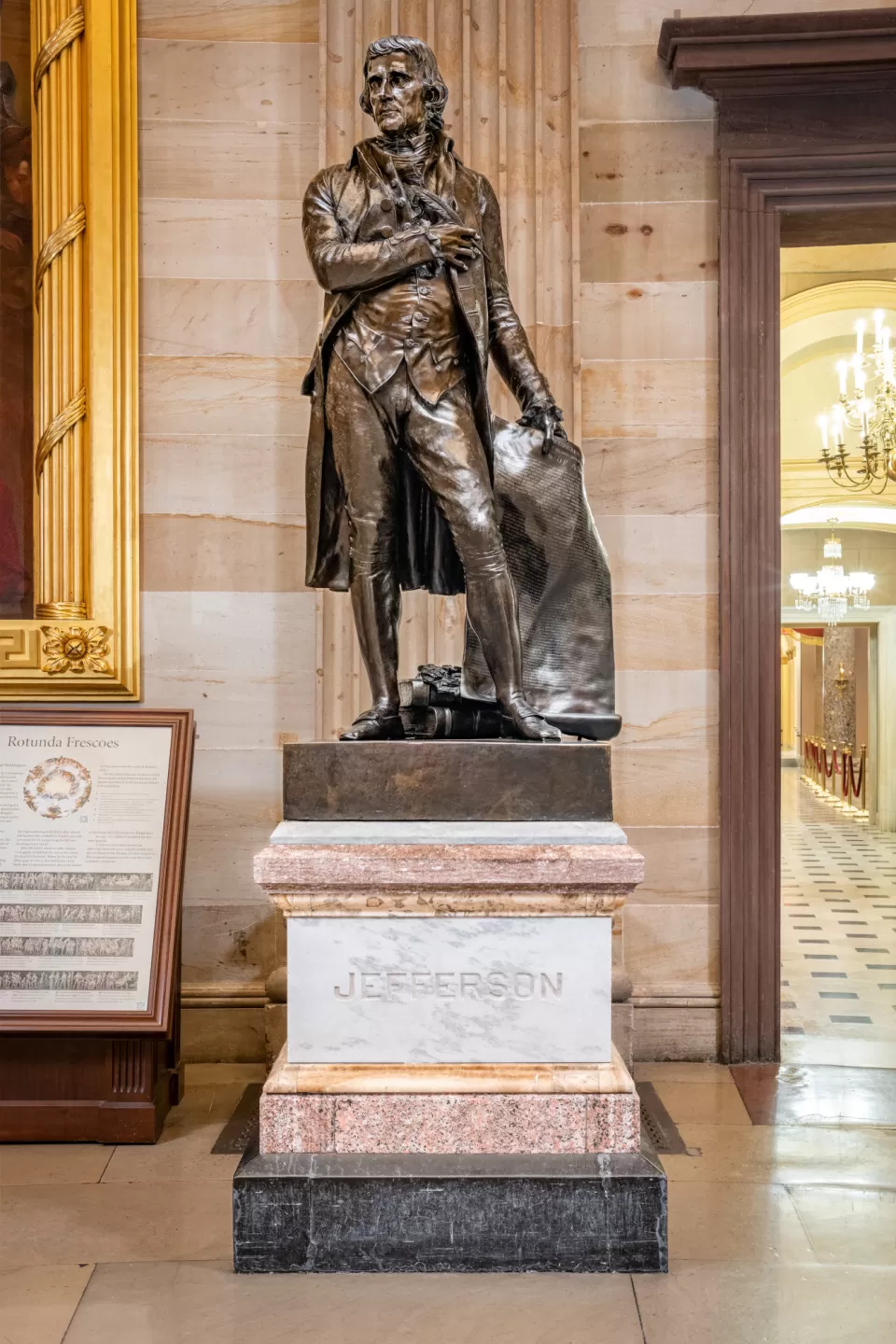
Following Houdon, the great Romantic sculptor Pierre-Jean David d'Angers (1788-1856) took center stage as a leading sculptor of monumental art and official portrait statues. Like Houdon, it is likely that he also influenced American artists by virtue of the fact that his statue of Thomas Jefferson was displayed in the nation's Capitol since the mid-nineteenth century. Thomas Jefferson (1833) stands opposite the statue of Washington in the U.S. Capitol Rotunda, flanking the south doorway leading to Statuary Hall.

Image
The Thomas Jefferson portrait statue by David d'Angers.
Photo by
Thomas Hatzenbuhler
Image
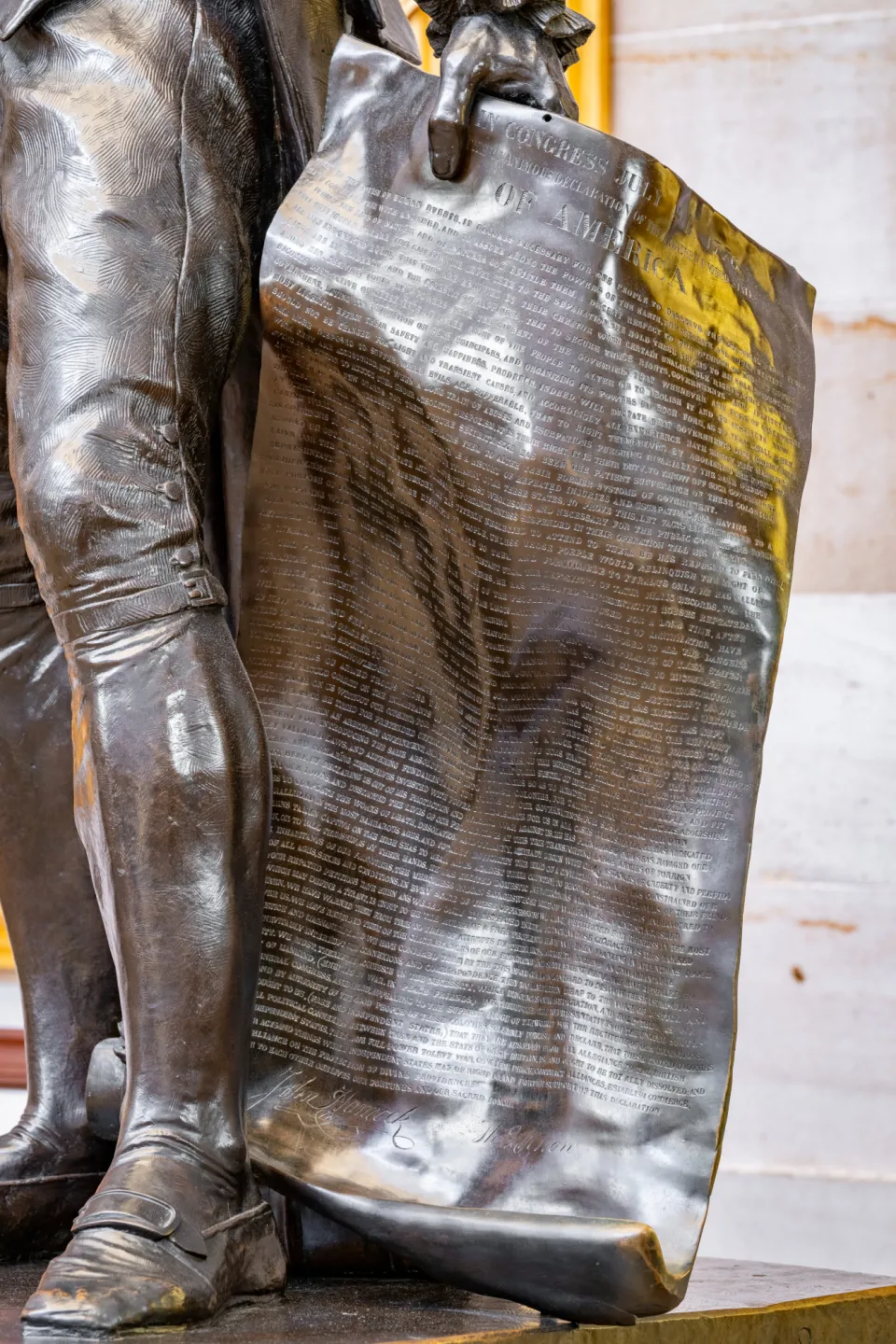
Jefferson's left hand holds the Declaration of Independence.
Photo by
Thomas Hatzenbuhler

The statue of Jefferson is not part of the National Statuary Hall Collection and was commissioned by Uriah P. Levy, the first Jewish naval officer, as a gift to the American people. Levy greatly admired Jefferson's commitment to religious freedom, and it was the Levy family that saved Monticello. For almost 40 years the statue stood outside near the White House, until 1874 when it was refurbished and brought back to the Capitol, just when the National Statuary Hall Collection was being established.

David d'Angers' career spanned the first half of the 19th century, and he firmly embraced the ideals of the 1789 French Revolution: Liberté, Égalité, and Fraternité. He believed in the power of art to improve the human condition, to ennoble humankind. In his sculpture, he strove for a heightened emotionalism, rooted in gesture, which he described as the "language of sculpture." In 1839 David d'Angers wrote:

“The attitude, the gaze, must precede speech as lightning precedes thunder. In art, gesture is the most powerful means of expression in that it reveals a soul so profoundly full of feeling that, impatient to express itself, it chooses the most rapid signs.”

David d'Angers sculpted this statue in France, where it was cast at the foundry of Honoré Gonon. In his right hand, Jefferson holds a quill and in his left is an unfurled Declaration of Independence. David d'Angers presents a contemplative Jefferson, frozen in the act of thinking and writing.

Henry Kirke Brown, the first artist to win a commission for the National Statuary Hall Collection (his 1870 statue of Rhode Island's Nathanael Greene), admired David d'Angers' statue and encouraged Senator Charles Sumner of Massachusetts to have it moved to Statuary Hall. Like David d'Angers, Brown also wanted to imbue his works with a convincing naturalism based on careful observation, and he won an additional three commissions for Statuary Hall: George Clinton, given by New York in 1873; Philip Kearny, given by New Jersey in 1888; and Richard Stockton, given by New Jersey in 1888.

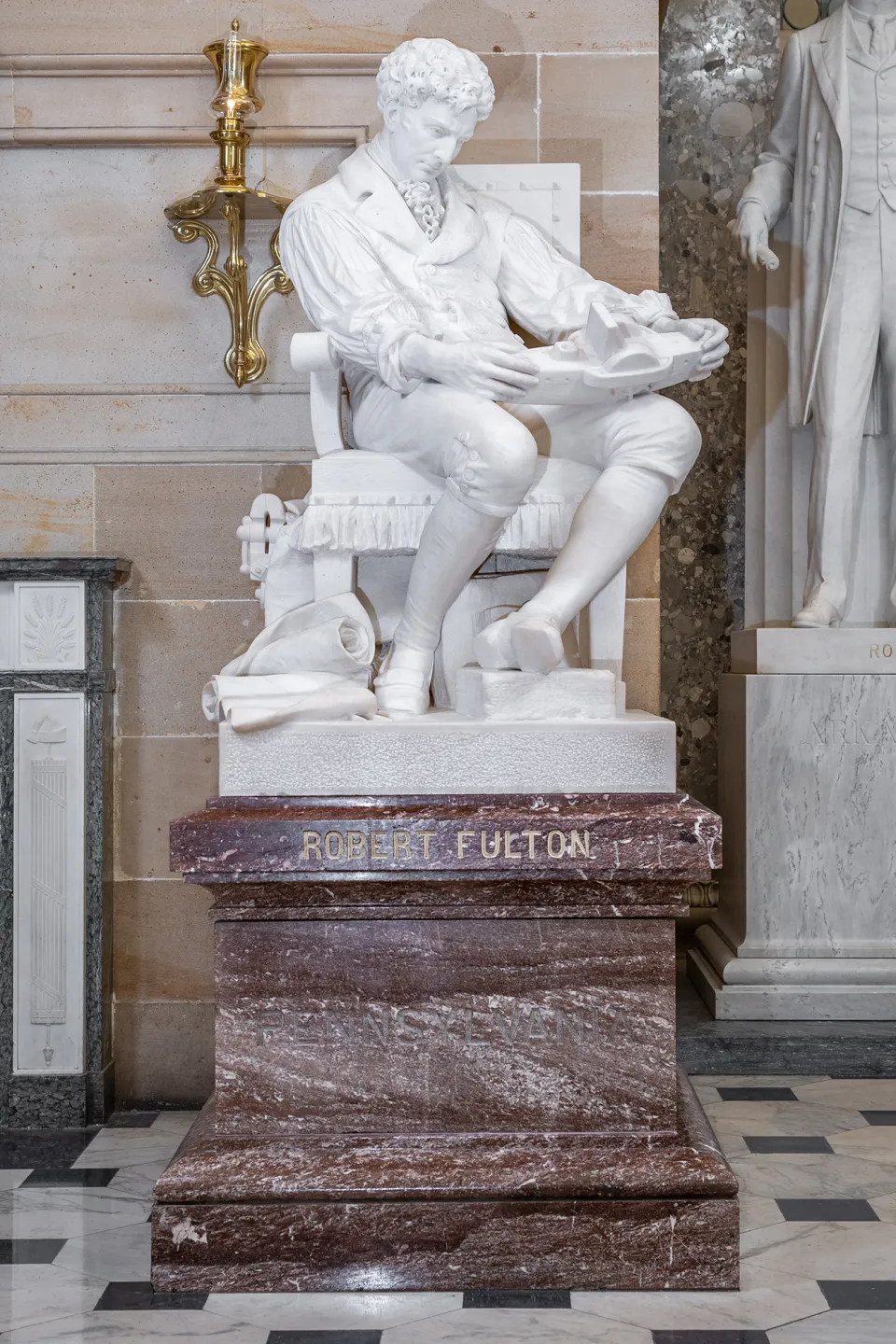
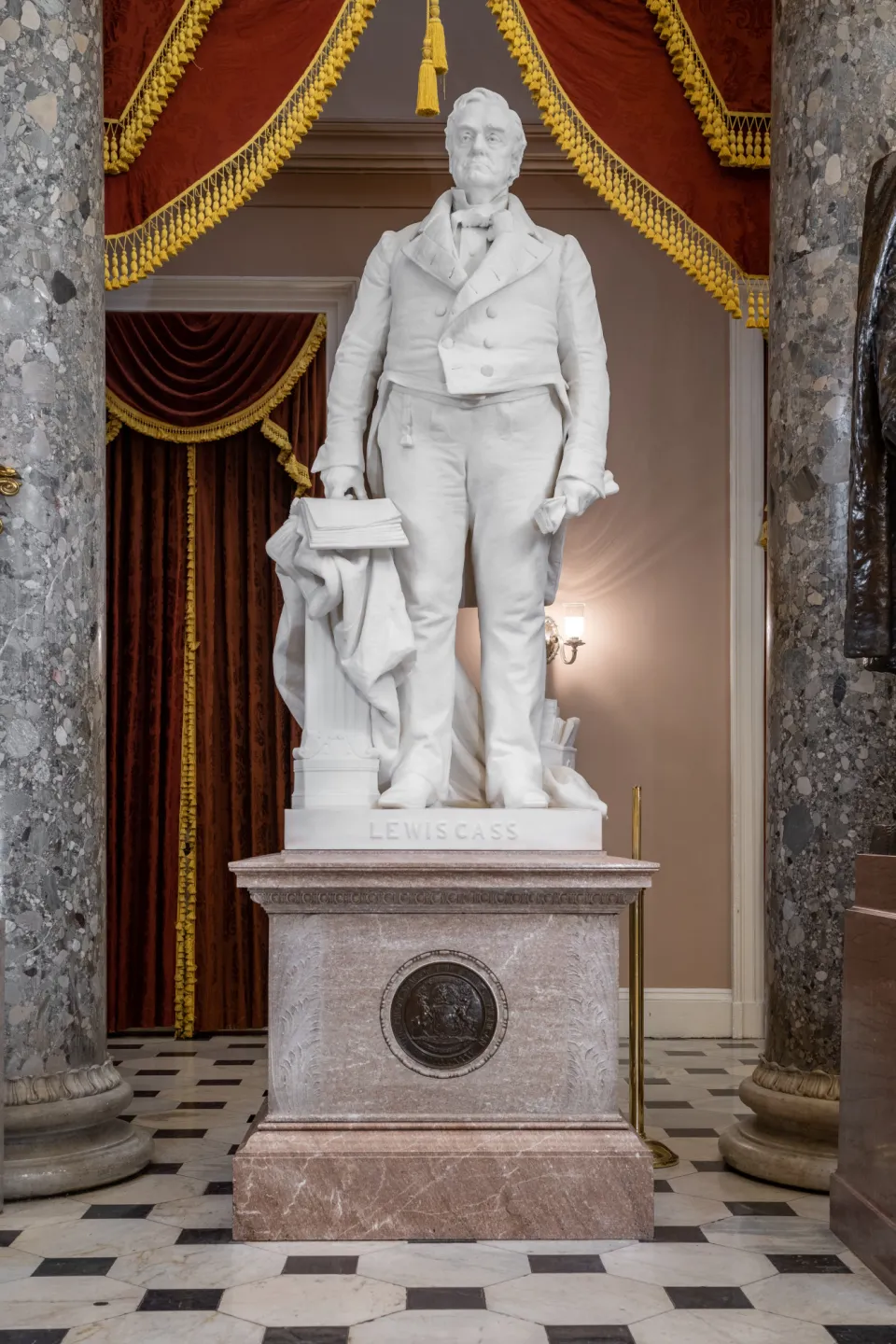
In the 1880s, two notable statues entered the collection: Michigan's Lewis Cass, completed by Daniel Chester French (1850-1931) in 1888, and Pennsylvania's Robert Fulton, completed by Howard Roberts (1843-1900) in 1883. Of these two artists, French had a national reputation; Roberts, although highly respected, was better known regionally in Philadelphia. In approaching their commissions, both artists included a fair amount of realistic detail but never lost sight of the volumetric nature of solid forms. They carefully studied their subjects and presented them in characteristic poses and activities.

Image
Marble portrait statue of Robert Fulton by Howard Roberts.
Photo by
Thomas Hatzenbuhler
Image
Statue of Lewis Cass in the U.S. Capitol's National Statuary Hall.
Photo by
Thomas Hatzenbuhler

Working from photographs, French was able to capture a highly individualistic portrait of Cass, whereas, without available source material, Roberts created a more idealized Fulton as a youthful inventor. Roberts shows him seated, engrossed in studying his model steamboat, with his rolled-up sleeves and piles of books nearby. Unlike Cass, Fulton in his workshop appears to be unaware of his audience.

French completed the statue of Cass shortly after his year-long sojourn (1886/1887) in Paris, where he studied Beaux-Arts sculpture and perfected a lively modeling technique. The statue depicts Cass as he was, without pretense, in the act of concluding a Senate speech. French deftly portrays Cass's features and expression, and one has the sense that he stands in a characteristic pose, weight solidly distributed on both legs. The sculptor realistically portrays 19th-century attire, even leaving the jacket partially unbuttoned.

Lorado Taft, himself a sculptor and the author of the first comprehensive book on American sculpture, reflected on French's Cass statue:

“With all its solidity, the artist has so well treated the surface, has made the flesh so mellow and the drapery so crisp and full of color, that the figure easily takes its place among the best portrait statues of the country. It unites admirable characterization with no less attractive technique.”

In contrast to French, 20th-century sculptor Jo Davidson (1883-1952), often described as a "plastic historian," wedded the informality of modernity with traditional portraiture. He strove to present people in a naturalistic way, almost like a photographic snapshot rather than a posed study. He often sculpted his subjects as he conversed with them to better capture their facial expressions and gestures. If he was unable to model a portrait from life, he preferred to work from film clips.

Image
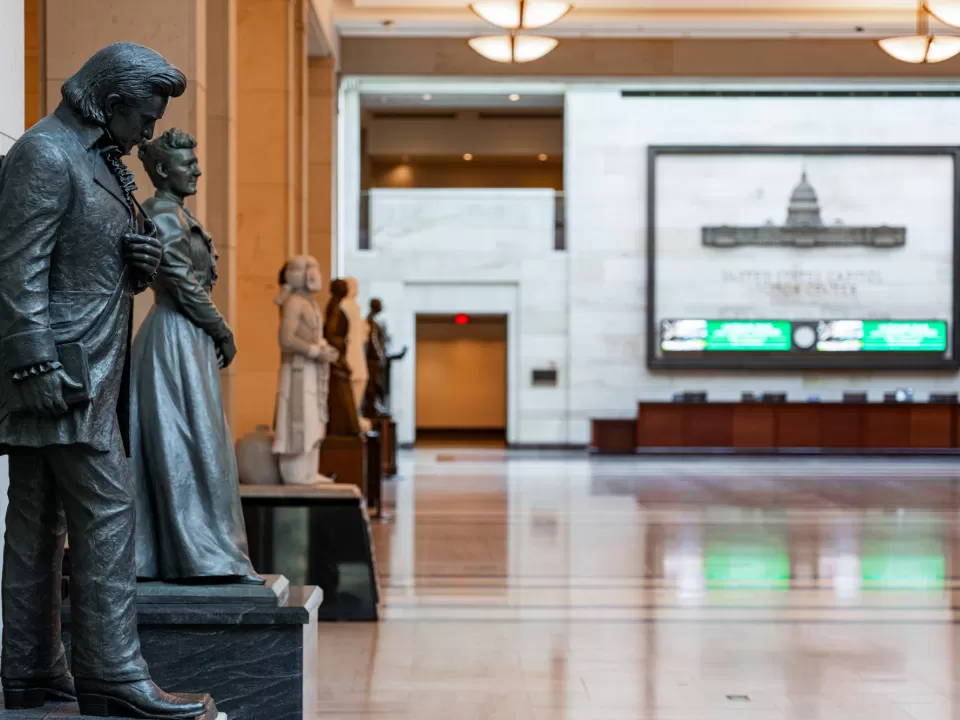
A line of portrait statues seen in the Capitol Visitor Center's Emancipation Hall, 2025.
Photo by
Rodney Norman
Image
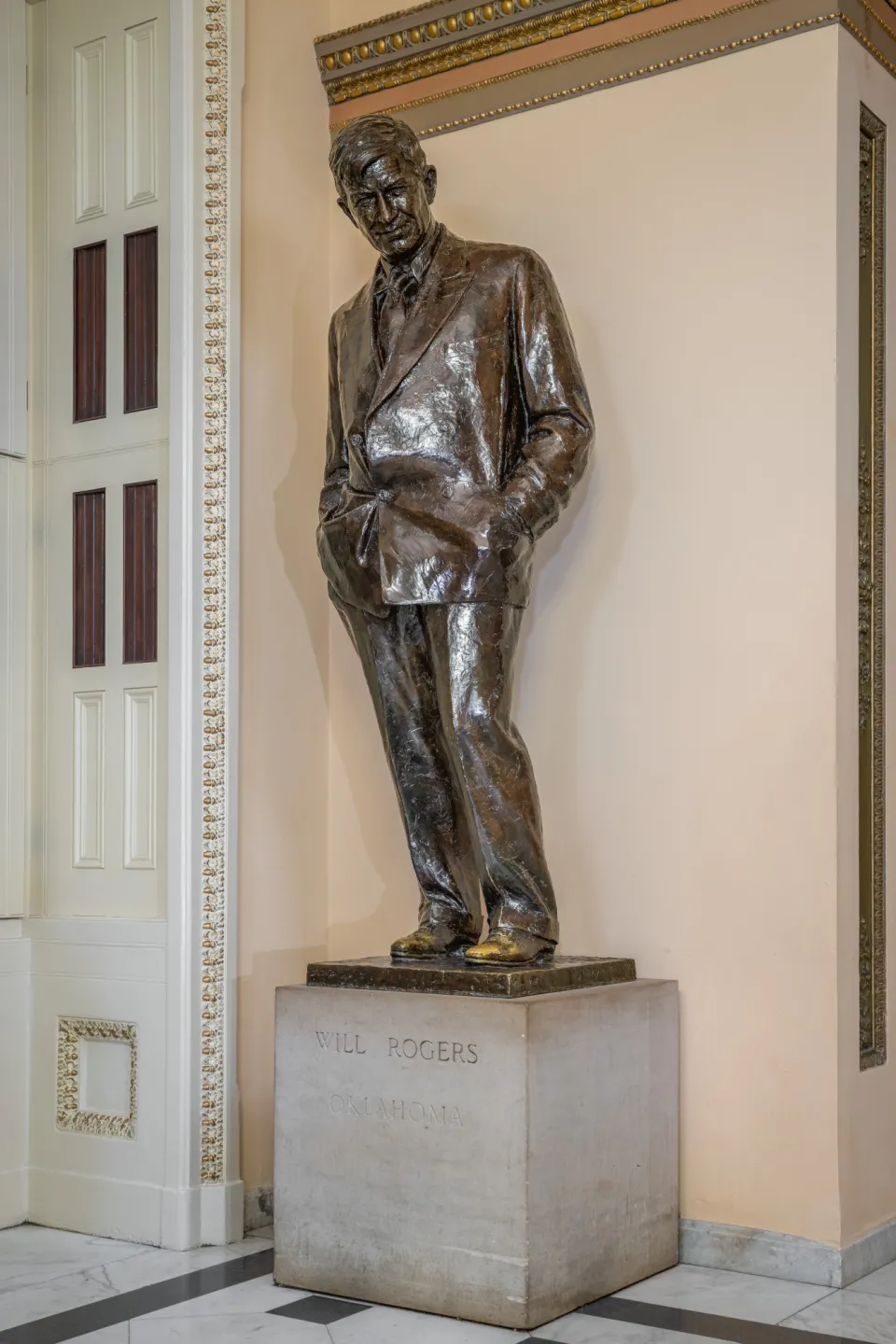
Statue of Will Rogers in the House wing of the U.S. Capitol.
Photo by
Thomas Hatzenbuhler

Davidson's statue of Oklahoma's Will Rogers (completed in 1938) regularly appears on the nightly news, seeming to watch the comings and goings of representatives with a bemused expression, befitting the humorist. Rogers stands casually with his hands in his pockets, his weight in a classical contrapposto, his head slightly cocked with a smile forming on his lips, looking down toward the ground as a "folksy" commentator often does before delivering a wry remark.

Over time, artists have continued to reinvent the portrait statue. The best examples present a convincing likeness of the subject, coupled with authentic gestures and details that effectively communicate with contemporary audiences. Modern additions to the National Statuary Hall Collection may use new sculpting techniques, such as computer-controlled rough carving, and some embrace styles quite different from the realistic naturalism of the 19th century. Regardless, the ones that call to mind Lafayette's observation, "That is the man himself. I can almost realize he is going to move," are the ones people remember.
 

Add a new comment

The content of this field is kept private and will not be shown publicly.

Plain text

  • No HTML tags allowed.
  • Lines and paragraphs break automatically.
  • Web page addresses and email addresses turn into links automatically.

Join Us on Social

Follow @uscapitol on X or Instagram for more.

Our Stories

Recent Articles
History & Discoveries

Capitol Extra! Magna Carta Replica and Display

Our Curator, Dr. Michele Cohen, is in the Capitol Crypt for the Magna Carta's anniversary. This entire display was made in England by artist Louis Osman, who had also crafted the crown for the investiture of Prince Charles.
History & Discoveries

Revolutionary Paintings by John Trumbull

Our Curator takes a deeper look at the four large history paintings by John Trumbull in the U.S. Capitol Rotunda, which depict pivotal moments before, during and after the Revolutionary War. #America250