Since 1951, the National Society of Professional Engineers has celebrated National Engineers Week to coincide with the birthday of George Washington, our first president and one of the United States' most lauded engineers and surveyors. The week is meant to draw attention to the many contributions and achievements of engineers across the country.

Robert Fulton was born in Lancaster County, Pennsylvania, in 1765. He had a lifelong interest in scientific and engineering developments, especially in canal systems and the application of steam engines. Fulton secured English patents for machines with a wide variety of functions and is best known for inaugurating the first commercial steamboat service in the world in 1807.

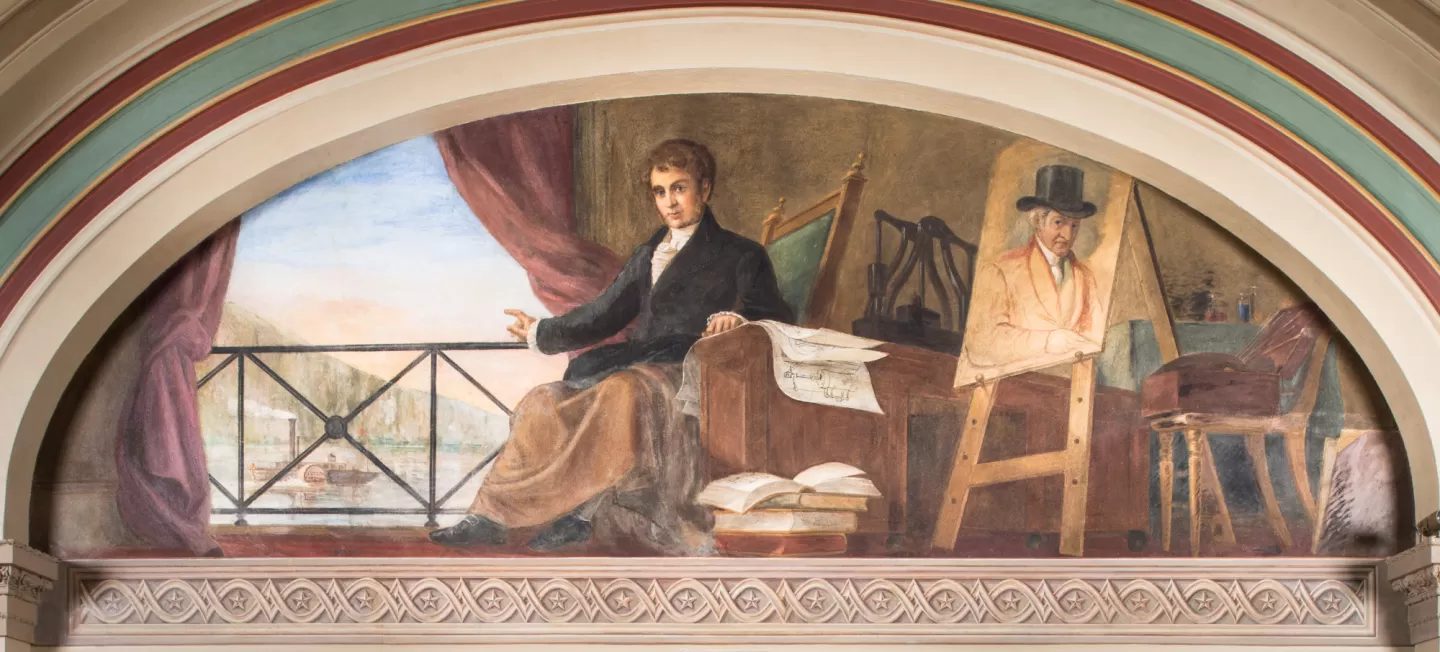
These six works of art on the Capitol campus feature or include Fulton's likeness.

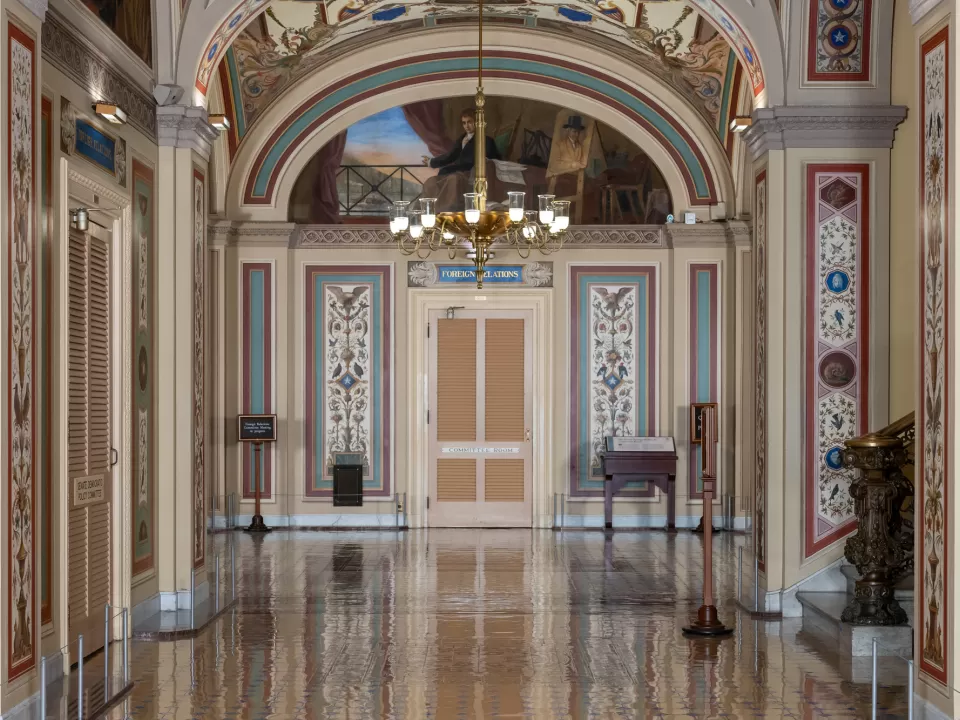
On the first floor of the Senate wing, a lunette of Fulton (cover image) appears above room S-116 at the east end of the Brumidi Corridors in an open hall area called the Patent Corridor. The Committee on Patents originally occupied the room, which now serves as a primary meeting space for the Senate Committee on Foreign Relations.

Image
Image
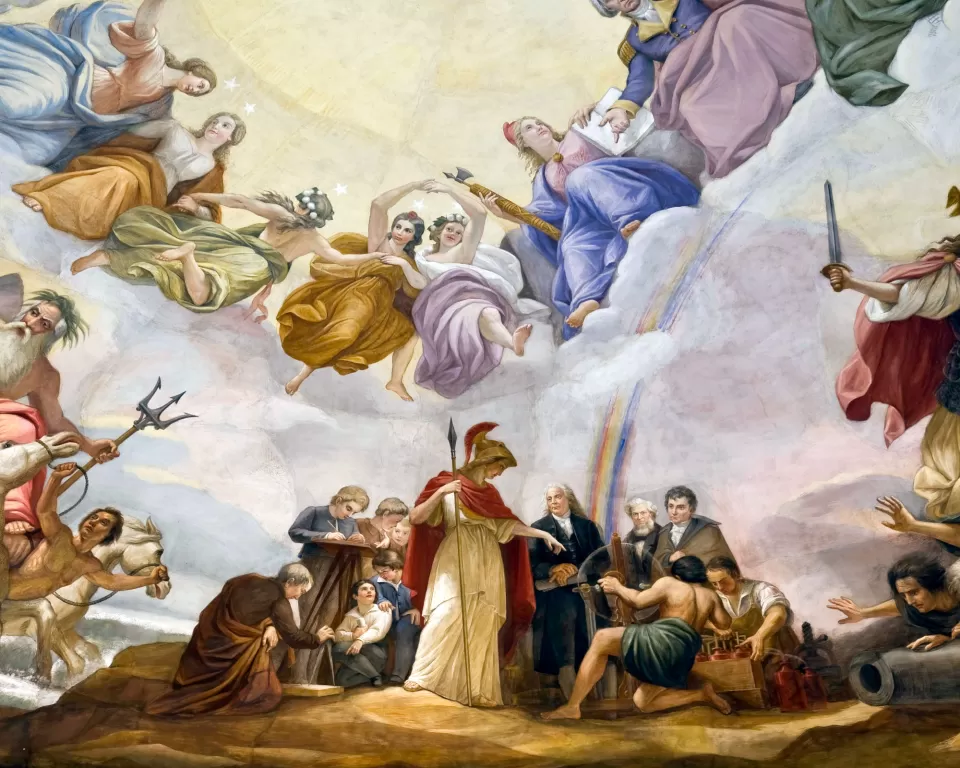
"Science," with Minerva teaching Benjamin Franklin, Robert Fulton, and Samuel F.B. Morse.
Brumidi's lunette of Fulton; a portion of Brumidi's "The Apotheosis of Washington."

Upstairs in the U.S. Capitol Rotunda, another portrait of Fulton by Constantino Brumidi can be seen by looking up at The Apotheosis of Washington, where he stands to the right among members of the Science group being taught by Minerva, goddess of wisdom, commerce and the arts.

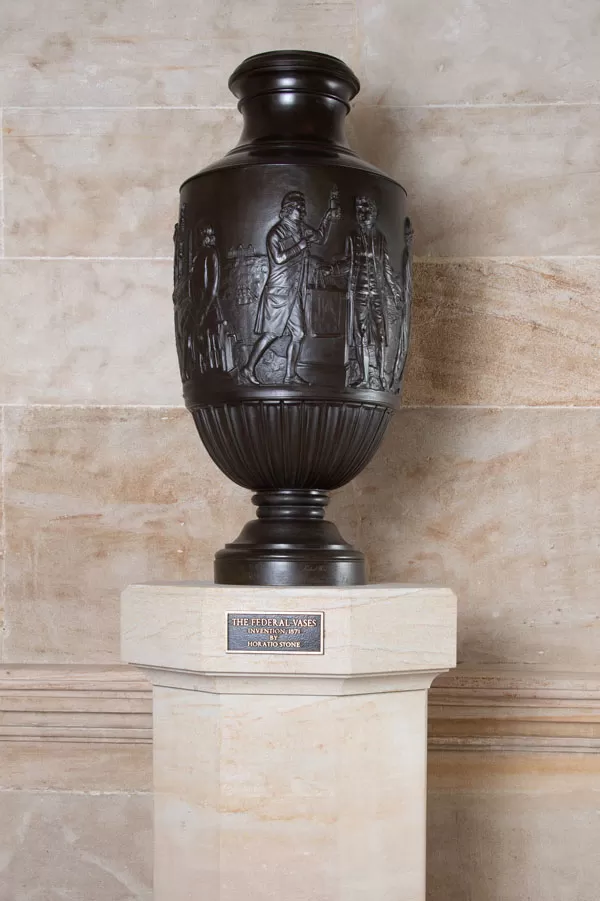
Just beyond the east entrance to the Rotunda are a pair of bronze Federal Vases displayed in the vestibule. The vase referred to as Invention shows Fulton depicted offering his design for the steamboat to a figure of Freedom personified by a male figure wearing a liberty cap.

Image
Image
The vase referred to as "Invention" in the U.S. Capitol.

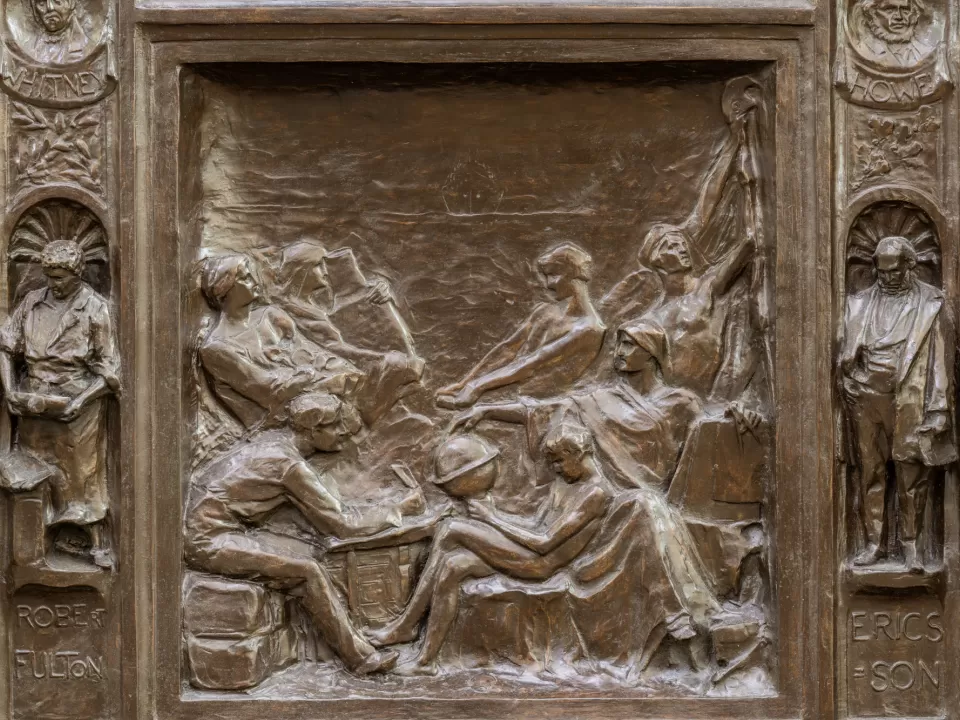
Fulton takes statuette form on a set of magnificent bronze doors placed on the first floor of the House wing. In the neighboring panel, a figure symbolizing Naval Architecture shows figures of Commerce and Agriculture the places on a globe where they can sell their wares.

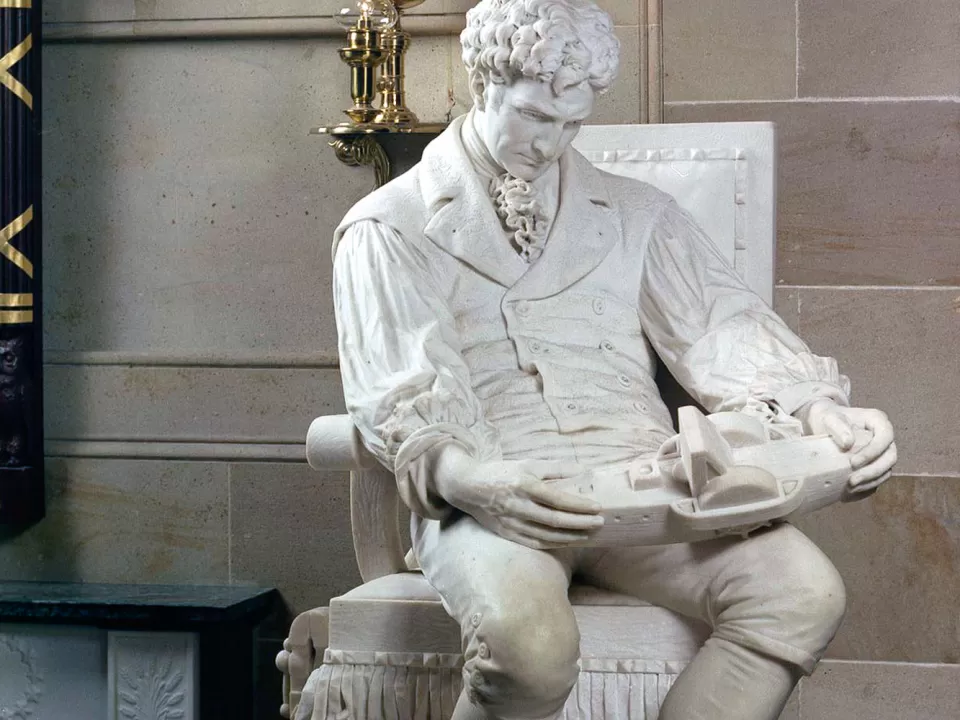
A larger than life-sized marble statue of Fulton is part of the U.S. Capitol's National Statuary Hall Collection, given by Pennsylvania in 1889.

Image
Image
Image

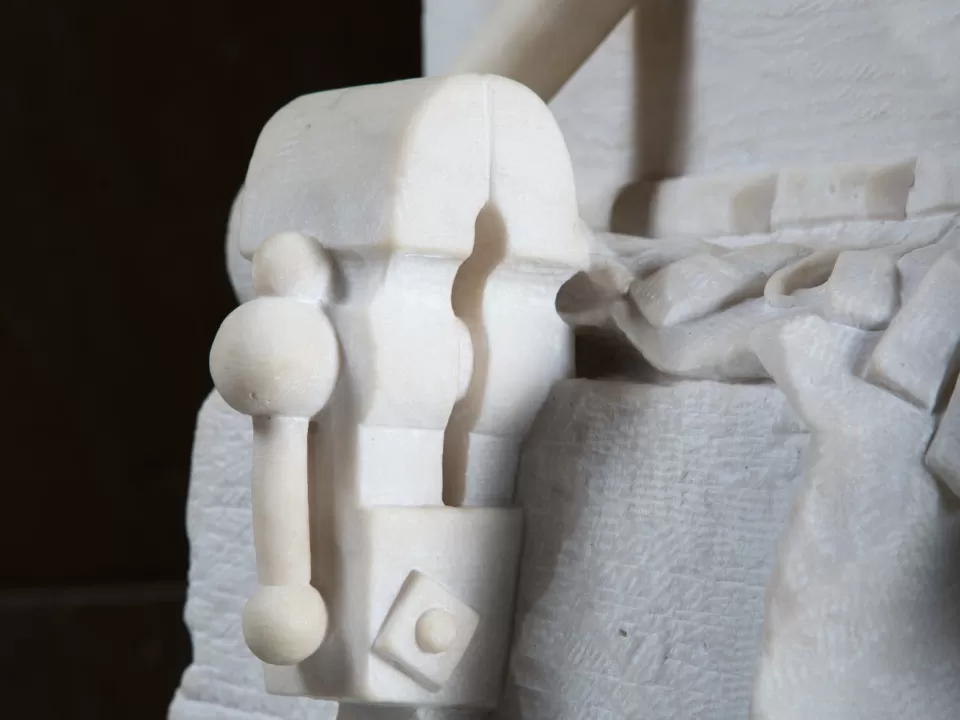
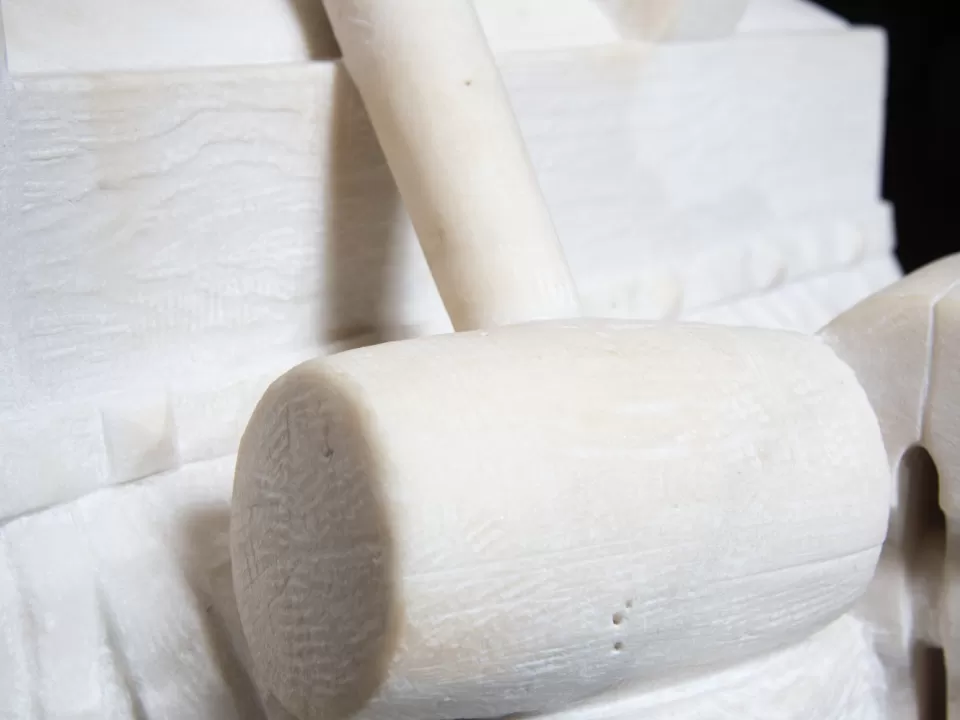
The statue portrays Fulton sitting in a chair holding a model of a steamboat with both hands. Next to him and near his feet are a vise and mallet, along with other tools, books and papers.

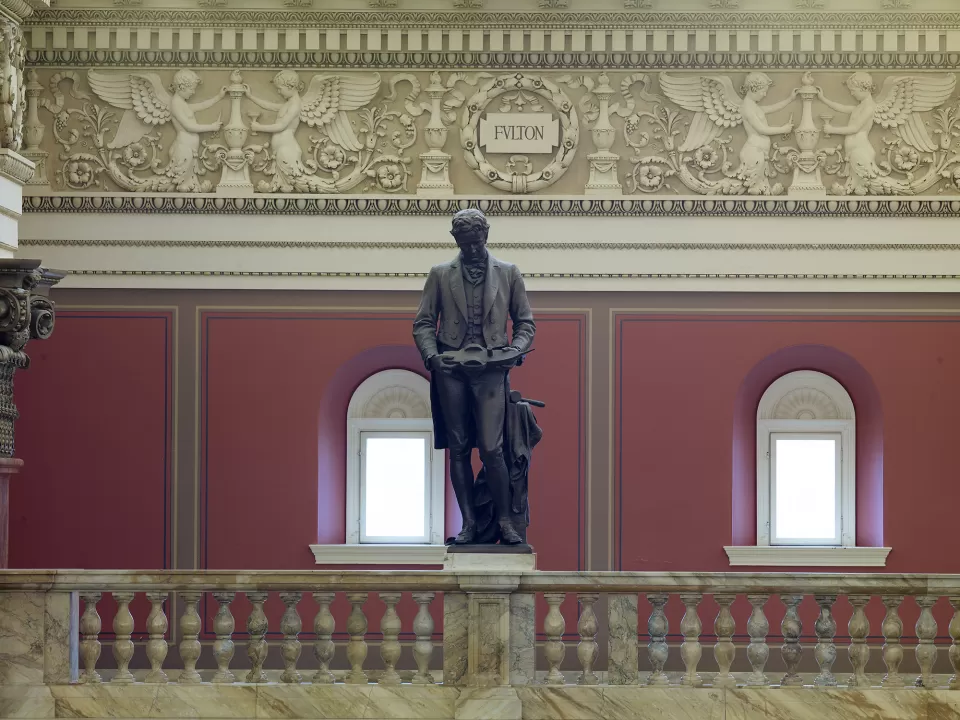
An additional depiction of Fulton is across the street from the U.S. Capitol in the Library of Congress' Thomas Jefferson Building.

Image
Main Reading Room. Portrait statue of Fulton along the balustrade. Library of Congress Thomas Jefferson Building, Washington, D.C. Washington D.C, 2007. Retrieved from the Library of Congress, https://www.loc.gov/item/2007684404/.
Photo by
Highsmith, C. M., photographer. (2007)
Image

The Main Reading Room has eight giant marble columns, each with an allegorical female figure at the top and bronze statues on either side paying homage to related individuals. This statue of Robert Fulton by Edward C. Potter stands upon the balustrade next to the figure representing Commerce.

Full Steam Ahead

There are several other works of art in the U.S. Capitol connected to the engineering marvel of steam power.

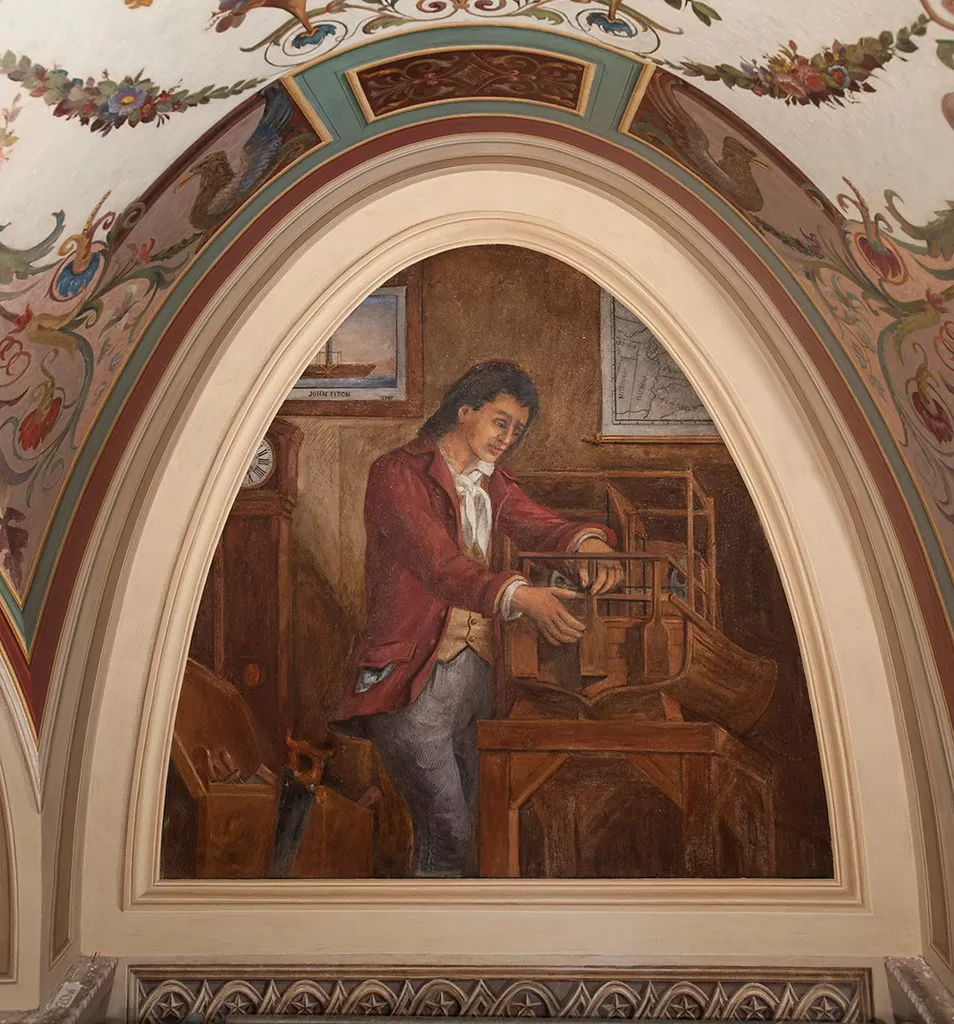
In the same Senate corridor where Fulton's lunette can be found, Brumidi created a similar fresco of another important engineer and inventor: John Fitch, who invented America's first steamboat, receiving a patent for it in 1791.

Image
Image

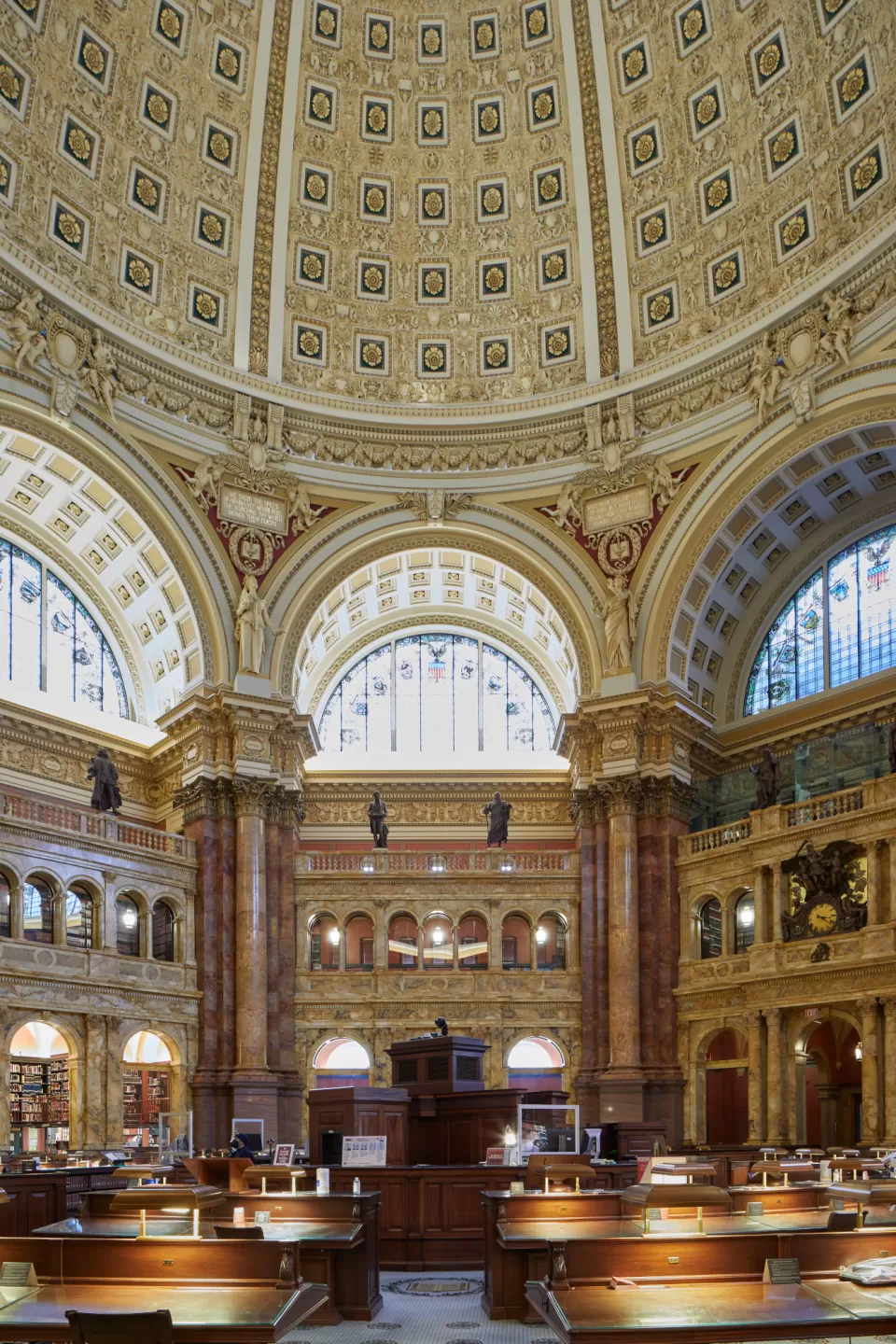
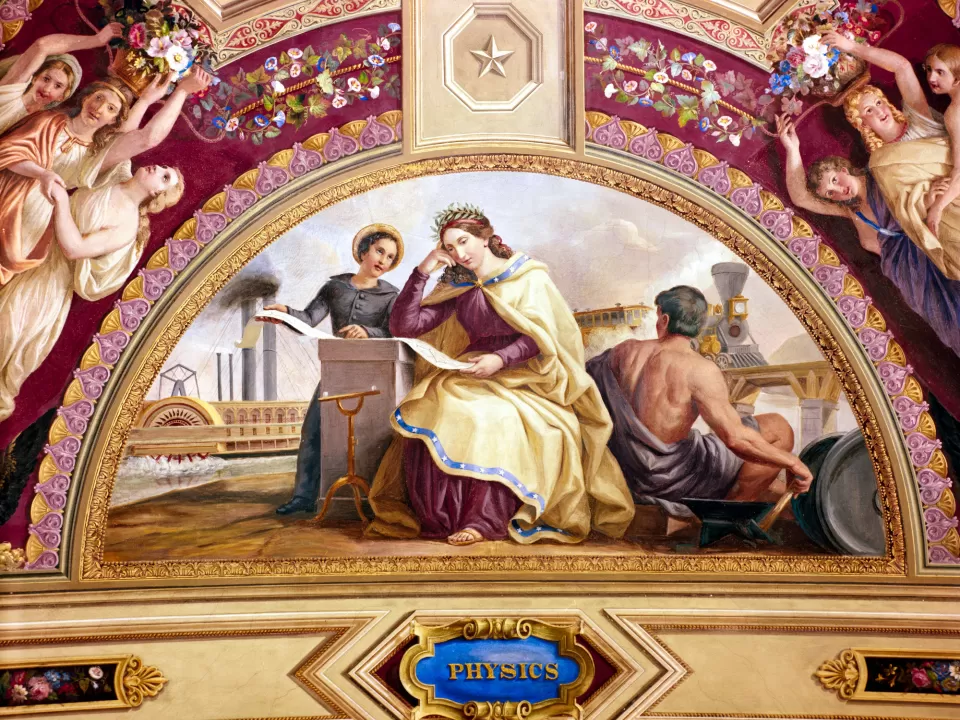
The U.S. Capitol room intended for the Senate Library, now a meeting space named the Lyndon B. Johnson Room, has designs by Brumidi that embody various fields of knowledge. His Physics scene shows how science has been applied to creating new modes of transportation. A paddle-wheel steamboat and steam locomotive crossing a bridge appear in the background.

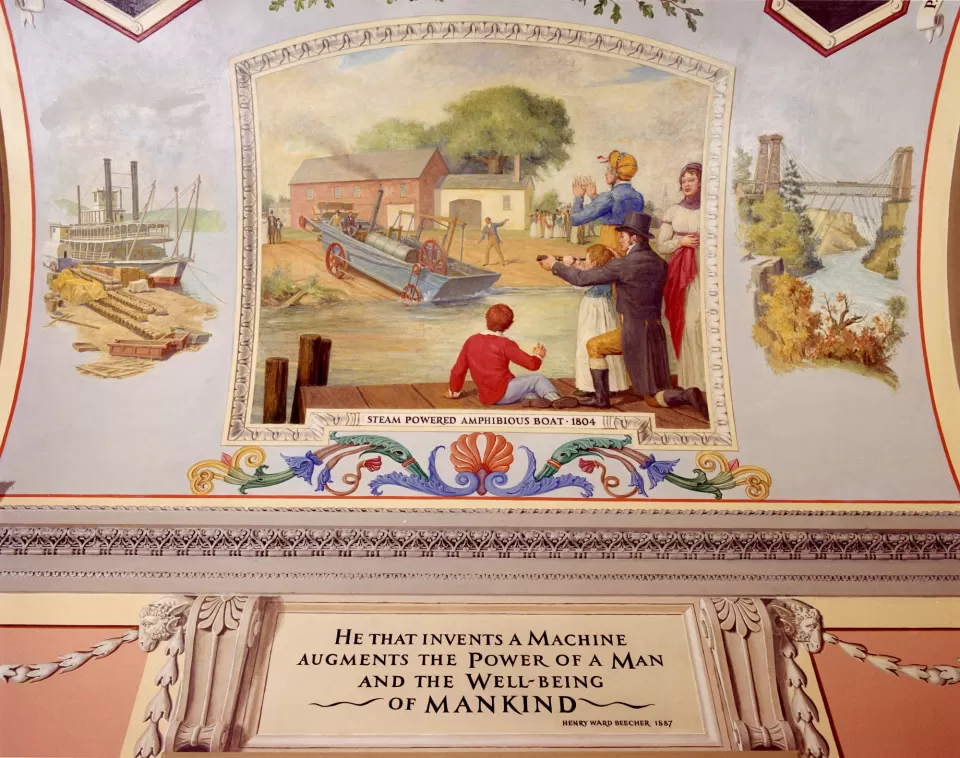
Over in the House wing of the U.S. Capitol, this mural by Allyn Cox (below) illustrates the nation's first steam-powered amphibious dredging scow, using one of American inventor Oliver Evans' engines, entering the Schuylkill River.

Image
"Steam Powered Amphibious Boat, 1804" by Allyn Cox

The vignette on the left is a steamboat on the Platte River, and the vignette on the right is the world's first railroad suspension bridge (designed by John Roebling) across the Niagara River, symbolizing steam-powered land travel. Above the bridge is a medallion portrait of Peter Cooper, who designed and built the first American steam locomotive, the Tom Thumb.

Visitors can see a few of these Brumidi works, plus National Statuary Hall, on various public tours offered through the U.S. Capitol Visitor Center.

Add a new comment

The content of this field is kept private and will not be shown publicly.

Plain text

  • No HTML tags allowed.
  • Lines and paragraphs break automatically.
  • Web page addresses and email addresses turn into links automatically.

Our Stories

Recent Articles
History & Discoveries

Capitol Extra! Magna Carta Replica and Display

Our Curator, Dr. Michele Cohen, is in the Capitol Crypt for the Magna Carta's anniversary. This entire display was made in England by artist Louis Osman, who had also crafted the crown for the investiture of Prince Charles.
History & Discoveries

Revolutionary Paintings by John Trumbull

Our Curator takes a deeper look at the four large history paintings by John Trumbull in the U.S. Capitol Rotunda, which depict pivotal moments before, during and after the Revolutionary War. #America250